
Whether you’re laying a brand-new driveway or budgeting for the cost to replace an asphalt driveway that’s seen better days, understanding what drives the price helps you avoid surprises and make a smarter investment. The asphalt driveway cost depends on far more than just the area site preparation, base condition, mix type, and even your distance from the asphalt plant all play a role.
In this guide, we break down every cost element, compare asphalt against other popular driveway materials, and explain the factors that influence your final quote.
How Much Does an Asphalt Driveway Cost in Australia?
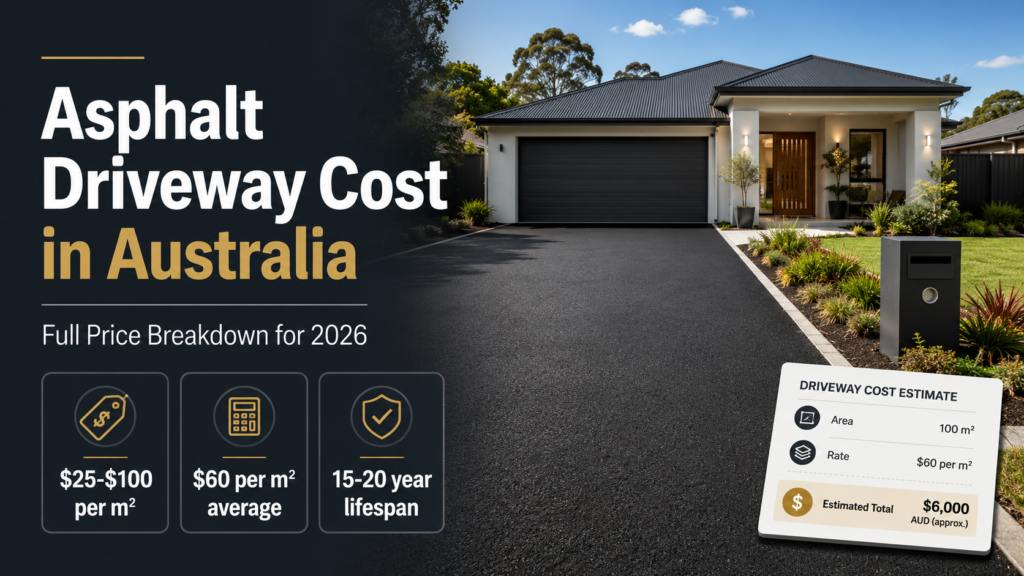
The average asphalt driveway cost in Australia ranges from $25 to $100 per square metre, with most standard residential projects falling around $60 per square metre once base preparation, materials, and labour are factored in.
The reason for this wide range is that many driveways already have usable base material or an existing asphalt surface that can be reused, significantly reducing costs compared to a completely new installation on bare ground.
Here’s what typical projects look like at the mid-range:
| Driveway Size | Area | Estimated Total Cost |
|---|---|---|
| Single-car driveway | 30–50 m² | $1,500 – $4,000 |
| Standard double driveway | 50–80 m² | $3,000 – $6,000 |
| Large residential driveway | 100–150 m² | $5,000 – $10,000 |
| Semi-rural or long driveway | 200–500 m² | $8,000 – $25,000+ |
These figures are indicative. Actual pricing depends on your specific site conditions, location, and the scope of preparation work needed.
What’s Included in the Asphalt Driveway Installation Cost?
The asphalt driveway installation cost covers several stages, and understanding each one helps you see where your money goes.
Site Preparation
Before any hot mix asphalt is laid, the ground must be properly excavated, graded, and compacted. Site preparation includes removing the existing surface (if necessary), correcting drainage fall, and installing a compacted gravel or crushed rock sub-base. On sloped blocks or properties with poor drainage, this stage can account for 30–40% of the total driveway cost.
If the existing base is in good condition, this step may only require minor top-up work which is one of the biggest reasons costs vary so widely between projects.
Material Costs
The cost of an asphalt mix depends on the grade, aggregate size, and layer thickness. Standard residential driveways typically use a 25–40 mm layer of hot mix asphalt over a prepared base. Heavier-duty applications such as shared driveways, entries that handle delivery trucks, or commercial access points may require 40–50 mm or a denser mix, pushing material costs higher.
Asphalt and bitumen work together in every mix: bitumen acts as the binder that holds the crushed aggregate together, creating the durable asphalt surface you drive on. When you hear “bitumen driveway,” it’s referring to the same product.
Labour and Equipment
Professional asphalt laying requires specialised machinery, a paving machine, vibratory rollers, and a crew skilled enough to achieve even compaction and correct drainage gradients. Labour typically makes up 30–50% of the overall installation cost.
Drainage and Finishing
Adequate drainage protects the long term performance of any driveway. Depending on your block, the installer may need to incorporate channel drains, spoon drains, or adjust the surface gradient. Edging options from simple rolled edges to exposed aggregate borders or concrete kerbing also affect the final price.
Comparing Driveway Materials by Cost Per m²
Asphalt isn’t the only option, so it’s worth understanding how the cost per square metre stacks up against other common driveway materials before committing.
Asphalt Driveway Cost
Asphalt driveways are one of the most cost effective surfacing options, particularly for larger areas where economies of scale bring the per-square-metre rate down. The cost-effectiveness becomes especially pronounced on driveways over 150 m², where equipment mobilisation costs are spread across a larger surface.
With proper maintenance including resealing every 3–5 years asphalt driveways deliver a reliable lifespan of 15 to 20 years, and often longer.
Concrete Driveway Cost
A concrete driveway typically costs more upfront, starting around $60 per m² for a plain finish and climbing past $150 per m² for coloured, stencilled, or exposed aggregate finishes. Concrete also requires 3–7 days for curing before you can use it, compared to 1–2 days for asphalt.
While concrete can last 25–30 years, it’s prone to cracking and staining over time, and repairs are more complex and costly, often requiring full slab replacement rather than a simple patch.
Paved Driveway Cost
Pavers (clay brick, granite, limestone, sandstone, or coloured concrete) offer design versatility but come with higher labour costs, especially for curved or complex layouts. They also require a compacted sub-base, edge restraints, and ongoing maintenance to manage weeds and moss growth between joints.
For large or semi-rural driveways, paver costs can escalate quickly, making them less practical than asphalt for bigger areas.
Gravel Driveway Cost
Gravel is often the cheapest upfront option, but you get what you pay for. Gravel, crushed granite, and limestone surfaces are prone to rutting, sinkholes, dust spray, and loose stones. The ongoing maintenance and replacement costs make gravel a less cost effective choice over the long term, particularly on high-traffic driveways.
Recycled Asphalt: Variable Pricing
Recycled asphalt (profiled from old roads or car parks) is increasingly marketed as a budget option. However, quality varies significantly depending on the source material. Before choosing recycled asphalt, ask to see older installations to judge how the surface holds up over time, appearance, evenness, and maintenance requirements can be very different from a fresh hot mix asphalt surface.
Side-by-Side Material Comparison
| Factor | Asphalt | Concrete | Pavers | Gravel |
|---|---|---|---|---|
| Cost per m² | $25 – $100 | $60 – $150 | $50 – $100+ | $20 – $100 |
| Installation time | 1–2 days | 3–7 days | 3–7 days | 1–2 days |
| Lifespan | 15–20 years | 25–30 years | 20–25 years | 5–10 years |
| Maintenance level | Low (reseal every 3–5 yrs) | Medium (crack repair) | Medium-High (weed control, relevelling) | High (top-up, regrading) |
| Repair complexity | Low patch and reseal | High slab replacement | Medium lift and relay | Low add material |
| Best suited for | All sizes, especially large | Small–medium driveways | Small decorative driveways | Rural/temporary access |
Factors That Influence Your Final Asphalt Driveway Cost
Several factors that influence the total price go beyond the raw material. Understanding these helps you budget accurately and avoid invoice surprises.
Driveway size and shape: Larger, simple rectangular driveways cost less per square metre than narrow, curved, or multi-point designs that require more hand work and cutting. For driveways over 200 m², asphalt becomes increasingly cost effective compared to all other materials.
Existing surface condition: If the old surface needs to be ripped up and removed, demolition and disposal fees apply. However, in many cases the existing base can be partially or fully reused, reducing preparation costs significantly.
Sub-base quality: A solid, well-drained sub-base may only need minor gravel top-up. A waterlogged or unstable base requires deeper excavation, imported fill, and additional compaction adding $10–$20+ per m².
Access and logistics: Properties with tight access, steep grades, long distances from the road, or proximity to main roads (requiring traffic management) incur higher labour and transport charges.
Location and transport distance: The distance from the asphalt plant affects material delivery costs. Regional pricing across Perth, Sydney, Melbourne, Perth, and Adelaide can vary by 10–20%.
Thickness and mix type: A standard residential application uses 25–30 mm of asphalt. Driveways handling heavy vehicles or commercial traffic may need 40–50 mm or a stronger mix grade, increasing material costs accordingly.
Contractor expertise: Contractors vary in pricing depending on their experience, equipment quality, material specifications, and quality standards. Always compare quotes on a like-for-like basis the cheapest option isn’t always the best value.
How Long Does an Asphalt Driveway Last?
With proper maintenance, an asphalt driveway will serve you well for 15 to 20 years and many well-maintained surfaces last beyond that. The durability of asphalt depends heavily on how well you look after it. The basics include:
Seal coating every 3–5 years to protect the surface from UV damage, water penetration, and oil stains. The asphalt driveway maintenance cost for a reseal is modest typically $3–$8 per m², making it far cheaper than the cost of major repairs down the track.
Crack filling as soon as small cracks appear. Left untreated, water penetrates the base layer and accelerates deterioration especially through wet winters.
Avoiding heavy point loads from trailer jacks, skip bins, or car stands without load-spreading boards underneath.
Keeping drainage clear so water doesn’t pool on the surface or soften the sub-base over time.
Asphalt Driveway Replacement: When Is It Time?
If your existing asphalt is showing widespread cracking, significant drainage issues, or base failure (soft spots, potholes), resurfacing alone may not be enough. The cost to replace an asphalt driveway is typically 15–25% higher than a new installation on cleared ground, due to demolition and disposal of the old surface.
However, if the base is still structurally sound, an asphalt overlay (resurfacing over the top) can extend the life of your driveway for another 10–15 years at a lower cost than full replacement.
Frequently Asked Questions
How much does it cost to asphalt a driveway per m2?
The asphalt driveway cost per m2 ranges from $25 to $100 across Australia, depending on the site conditions, base preparation required, and mix type. Most standard residential driveways fall around $60 per square metre.
Is asphalt cheaper than concrete for a driveway?
Yes, in most cases. Asphalt typically costs $25–$100 per m² compared to $60–$150 per m² for concrete. Asphalt also installs faster and is significantly cheaper to repair, making it more cost effective over its lifespan.
How long does an asphalt driveway last in Australia?
With proper maintenance including resealing every 3–5 years, an asphalt driveway lasts 15 to 20 years. Some well-maintained surfaces exceed this comfortably.
What is the difference between asphalt and bitumen driveways?
They’re the same product. Bitumen is the binding agent used in asphalt it holds the crushed aggregate together. When people refer to a “bitumen driveway,” they mean an asphalt driveway.
Can you lay new asphalt over an old driveway?
In many cases, yes. If the existing base is structurally sound, a new asphalt overlay can be laid on top, saving the cost of full demolition and base reconstruction.
What factors affect asphalt driveway cost the most?
The biggest cost drivers are driveway size, sub-base condition, site access, and distance from the asphalt plant. A driveway on a well-prepared base with good access will cost significantly less than one requiring full excavation on a difficult site.
Get an Accurate Quote for Your Driveway
Every driveway project is different, and online estimates only go so far. The best way to lock in your asphalt driveway cost is to get an on-site assessment from a qualified Asphalt Driveways contractor who can evaluate your sub-base, measure the area accurately, and recommend the right mix for your needs.
Contact us today for a free, no-obligation quote, we’ll walk through every cost line so there are no surprises when the job begins.