A worn or cracked driveway can affect more than just the appearance of your property. Cracks, fading, potholes, and surface damage can make your driveway less safe and may eventually lead to more expensive repairs.
If the foundation is still strong, driveway resurfacing can be a practical alternative to full replacement. It gives the existing driveway a fresh surface without the cost and disruption of removing everything.
But how do you know whether resurfacing is right for your property? This guide explains the benefits of resurfacing a driveway, how it compares with replacement, and when each option makes sense for Perth homeowners.
What Is Driveway Resurfacing?
Driveway resurfacing involves repairing the existing surface and applying a new layer or coating. Professional asphalt paving can be used where asphalt is the chosen driveway material. Instead of excavating and removing the entire driveway, the existing base is retained when it is structurally sound.
Before resurfacing, professionals inspect the driveway, repair suitable cracks or damaged areas, and prepare the surface for the new layer. The exact process depends on whether the driveway is made from asphalt, concrete, or another material.
Resurfacing is mainly suited to driveways with surface-level problems rather than major foundation or structural damage.
Benefits of Resurfacing a Driveway
Cost Efficiency
One of the biggest benefits of driveway resurfacing is that it can cost less than a full driveway replacement.
Replacement usually requires removing the existing driveway, disposing of old materials, preparing or rebuilding the foundation, and installing a completely new surface. Resurfacing avoids much of this excavation, removal, and heavy labour.
The final cost still depends on the driveway’s size, condition, material, preparation work, and chosen finish. You can also use an asphalt calculator to get a better idea of the material requirements for an asphalt project.
Time and Convenience
A full driveway replacement can involve excavation, machinery, removal of old materials, foundation work, and new surface installation. This can create more disruption around your home.
Resurfacing generally involves fewer construction steps. That can mean a shorter project and less disturbance to your daily routine.
For homeowners who want to improve an ageing driveway without a major construction project, this can make resurfacing a convenient option.
Longevity and Durability
A properly prepared and professionally resurfaced driveway can provide many more years of useful service.
The new surface can help protect the existing driveway from everyday wear, vehicle traffic, weather exposure, and UV damage. However, resurfacing does not repair a failing foundation. If the underlying structure is weak, surface improvements alone may not provide a lasting solution.
Regular maintenance and good drainage are also important for getting the most from a resurfaced driveway.
Aesthetic Improvements and Curb Appeal
An old driveway can make an otherwise attractive property look tired. Faded surfaces, stains, small cracks, and discolouration can reduce curb appeal.
Resurfacing provides an opportunity to give the driveway a cleaner and more modern appearance. Depending on the system and material used, homeowners may have options for different colours, textures, patterns, and finishes.
For properties in Perth, a refreshed driveway can complement the home’s exterior and create a more consistent overall look.
Environmental Impact
Resurfacing can also reduce the environmental impact of a driveway project when compared with complete removal.
Because the existing driveway can remain in place, there may be less demolition waste going to landfill. Resurfacing can also require fewer new materials than building a completely new driveway.
The environmental benefits depend on the materials, preparation, transport, and construction methods used, but retaining a suitable existing base can help reduce unnecessary waste.
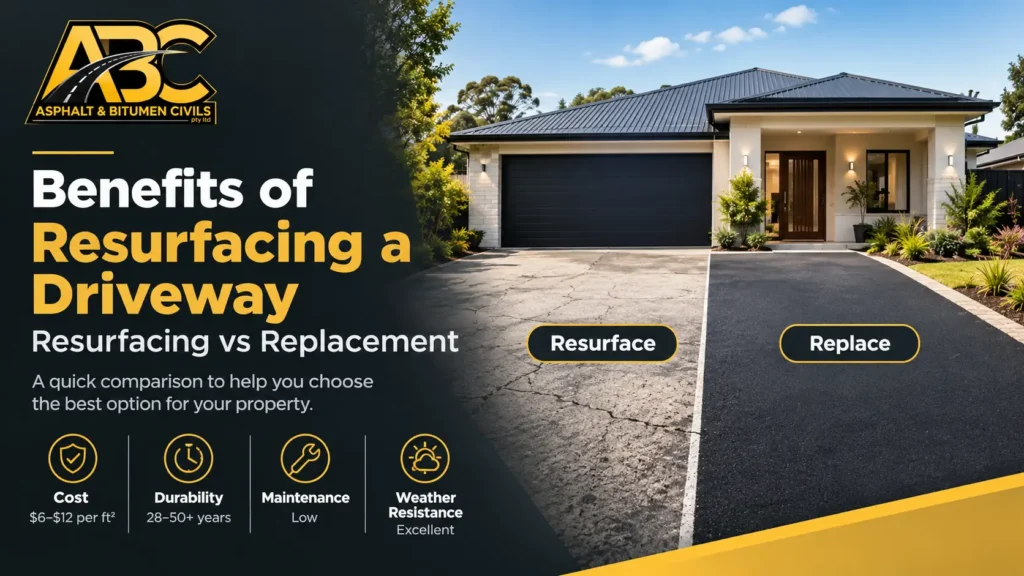
Driveway Resurfacing vs Replacement
| Feature | Driveway Resurfacing | Full Driveway Replacement |
| Process | Adds a new layer over the existing driveway | Removes the existing driveway and installs a new one |
| Cost | Generally more cost-efficient | Usually more expensive |
| Labour | Requires less labour | Requires more labour and machinery |
| Time | Typically faster to complete | Usually takes longer |
| Foundation | Existing foundation must be structurally sound | Foundation can be repaired or completely rebuilt |
| Best For | Minor to moderate surface damage | Serious structural damage |
| Cracks | Suitable for small surface cracks | Better for deep or widespread cracks |
| Potholes | Limited suitability depending on their cause | Better when potholes result from base failure |
| Waste | Produces less demolition waste | Generates more waste from removal |
| Appearance | Improves colour, texture and overall finish | Offers a completely new surface |
| Durability | Extends the useful life of the existing driveway | Provides a new driveway with potentially longer service life |
| Disruption | Less disruption to your property | More excavation, noise and disruption |
| Best Choice When | The base is stable but the surface looks worn | The base or foundation has significant problems |
Signs Your Driveway Needs Resurfacing
Your driveway may be a good candidate for resurfacing if you notice:
- Small or shallow cracks
- Fading or discolouration
- Minor surface wear
- A rough or ageing appearance
- Light surface imperfections
- General wear from vehicle traffic
- A structurally sound foundation
The key factor is the condition underneath the visible surface. If the base remains stable and there are no serious structural problems, resurfacing can restore the appearance and performance of the driveway without completely rebuilding it.
Signs Your Driveway Needs Full Replacement
Resurfacing is not suitable for every damaged driveway. Full replacement may be necessary when problems extend into the foundation or base.
Signs can include:
- Large or deep cracks
- Multiple or recurring potholes
- Significant sinking or uneven areas
- Soft or unstable sections
- Serious drainage problems
- Major foundation damage
- Damage caused by tree roots
- Extensive deterioration across the driveway
Covering serious structural problems with a new surface may only provide a temporary fix. If the underlying issue remains, the new surface can eventually develop similar problems.
In these situations, removing the existing driveway and addressing the foundation can provide a more reliable long-term solution.
Asphalt Resurfacing vs Replacement
For an asphalt driveway, resurfacing can be effective when the existing pavement is generally stable, but the surface has developed cracking, fading, or other wear.
Depending on the condition, damaged areas may need to be repaired before a new asphalt layer is applied. Drainage issues should also be addressed because trapped water can contribute to further deterioration.
Replacement becomes more suitable when the asphalt has extensive structural damage, major potholes, widespread failure, or a damaged base.
The same basic principle applies when comparing other driveway materials: surface damage may be suitable for resurfacing, while foundation problems usually require more extensive work.
Get a Free Quote for Your Driveway
Choosing between resurfacing and replacement depends on more than how old your driveway looks. The condition of the surface, foundation, drainage, existing material, budget, and your long-term plans should all be considered.
For homeowners in Perth, getting a professional assessment can help you avoid spending money on the wrong solution. Have your driveway inspected and contact our team to request a free quote and find out whether resurfacing or replacement is the right choice for your property.
Frequently Answer Questions
Is it cheaper to resurface or replace a driveway?
Driveway resurfacing is generally cheaper than full replacement because it requires less excavation, removal, materials and labour. However, the final cost depends on the driveway’s condition and size.
When should you resurface a driveway instead of replacing it?
Resurface your driveway when the surface is worn, faded or has minor cracks, but the underlying foundation is still strong and stable. Replacement is better when there is serious structural damage.
How long does driveway resurfacing last compared with replacement?
A professionally resurfaced driveway can extend the life of an existing surface for many years, while a full replacement generally offers a longer service life. Proper drainage and regular maintenance can improve either option.
Can a badly cracked or damaged driveway be resurfaced?
Severely cracked, sinking or pothole-filled driveways may not be suitable for resurfacing, especially if the base is damaged. In these cases, full replacement may provide a more reliable and long-lasting solution.