
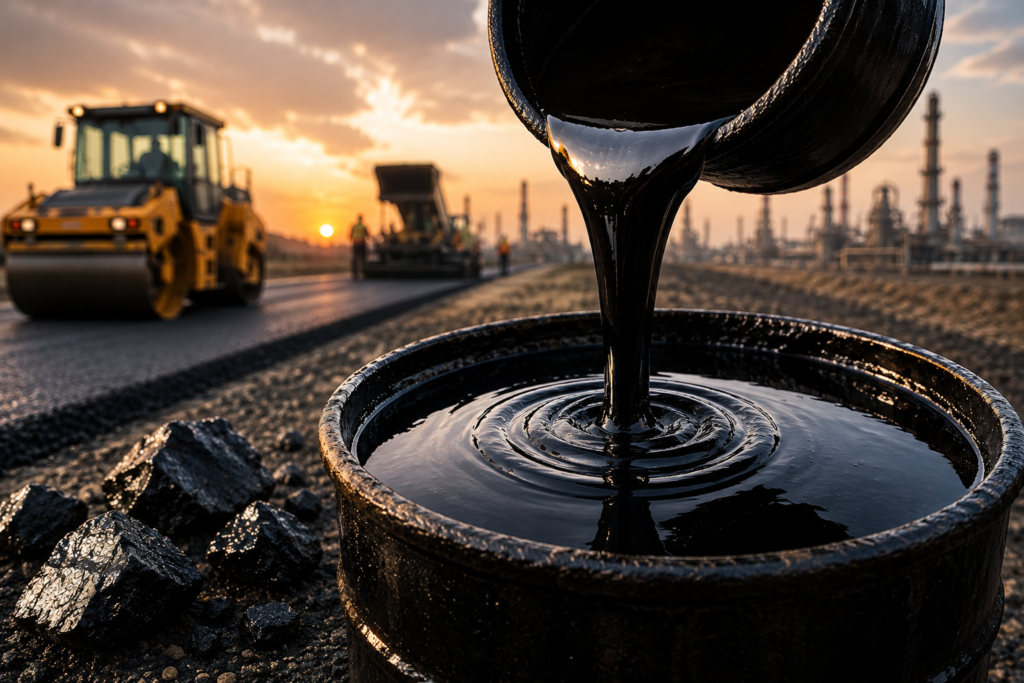
Bitumen is the dark, viscous material that plays a critical role in modern construction. From roads to roofing, it acts as a powerful binding and waterproofing agent. Derived from crude oil, bitumen has been used for thousands of years and remains essential in today’s infrastructure industry.
What is Bitumen?
Bitumen is a thick, sticky, black or dark brown petroleum product. At room temperature, it behaves like a semi-solid, but when heated, it becomes fluid and workable.
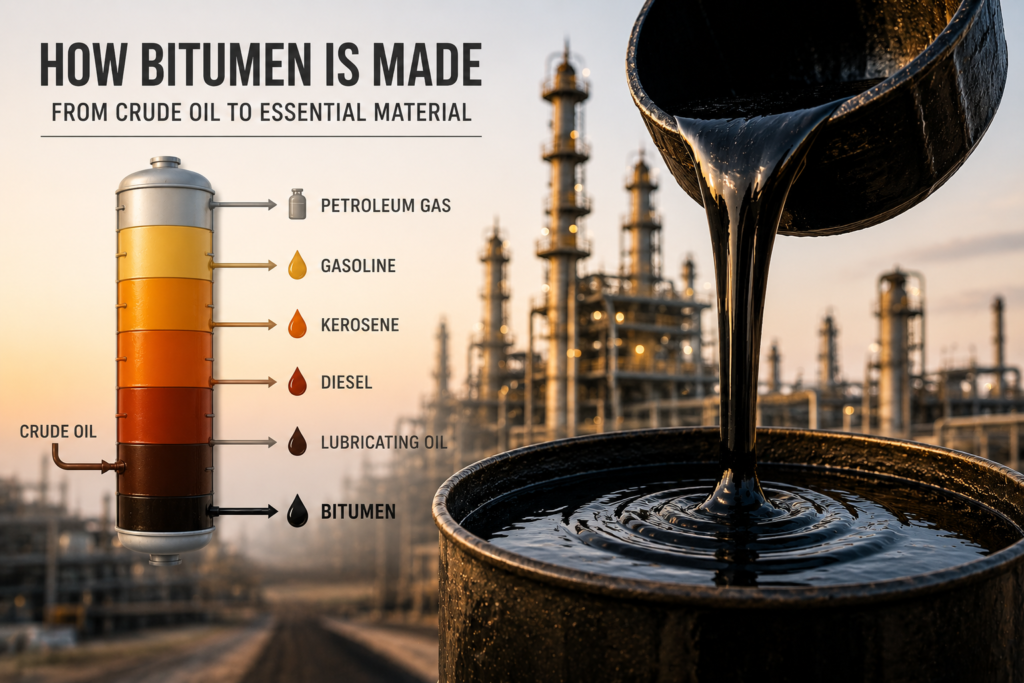
It is mainly produced as a by-product of crude oil refining, where lighter fuels like petrol and diesel are extracted, leaving behind dense bitumen.
Key Characteristics:
- Waterproof
- Highly adhesive
- Thermoplastic (softens when heated, hardens when cooled)
- Durable and long-lasting
Quick Facts about Bitumen
- Around 85% of bitumen is used in road construction
- It is insoluble in water, making it ideal for waterproofing
- Softening point: 45°C to 60°C
- Global market value exceeds $80 billion
- Natural bitumen exists in tar sands (Canada, Venezuela, Kazakhstan)
What is Bitumen Made Of?
Bitumen is composed primarily of polycyclic aromatic hydrocarbons, large, complex organic molecules made up of carbon and hydrogen atoms arranged in multiple ring structures. Its chemical composition varies depending on the crude oil source, but a typical sample breaks down as follows:
| Component | Percentage | Function |
| Carbon | 82–88% | Provides strength |
| Hydrogen | 8–11% | Forms hydrocarbon chains |
| Sulphur | 0–6% | Affects viscosity |
| Nitrogen | 0–1% | Improves adhesion |
| Oxygen | 0–1.5% | Adds chemical reactivity |
| Metals | <1% | Trace elements |
Main Components of Bitumen
Asphaltenes
Asphaltenes are the heaviest fraction of bitumen, large, complex aromatic molecules that give bitumen its dark colour, stiffness, and structural rigidity. They are insoluble in light alkanes (such as heptane) but soluble in aromatic solvents. The asphaltene content directly influences the hardness and temperature susceptibility of the final product.
Maltenes
Maltenes are the lighter, oily fraction of bitumen, themselves composed of three sub-groups: resins, aromatics, and saturates. They act as a dispersing medium for asphaltenes, giving bitumen its fluidity, elasticity, and adhesive properties. A higher maltene content produces a softer, more ductile bitumen.
How Bitumen is Made (Step-by-Step Process)
Crude Oil Intake
Crude oil is delivered to the refinery from primary sources, typically oil fields in the Middle East, the United States, Venezuela, or Russia. The oil’s composition varies significantly depending on its origin, which in turn affects the grade and quality of the bitumen produced.
Atmospheric Distillation
The crude oil is first heated to around 350–400°C in an atmospheric distillation column. Lighter fractions, liquefied petroleum gas (LPG), naphtha, kerosene, and gas oil, vaporise and are collected at progressively higher points in the column. The heavy residue remaining at the bottom is called atmospheric residue.
Vacuum Distillation
The atmospheric residue is then fed into a vacuum distillation unit, where reduced pressure allows further lighter fractions (vacuum gas oil) to be extracted without thermally cracking the heavier molecules. The material remaining at this stage is vacuum residue, the primary source of bitumen.
Air Blowing (for Oxidised Grades)
For certain applications, the vacuum residue is subjected to an air blowing process, where hot air is passed through the liquid bitumen at temperatures of 240–320°C. This oxidises the bitumen, increasing its softening point and hardness. Oxidised bitumen (also called blown bitumen) is used in industrial applications such as roofing and pipe coating.
Quality Testing & Grading
The finished bitumen undergoes a battery of tests, penetration, softening point, viscosity, ductility, and flash point to confirm it meets the required grade specification. It is then stored in insulated tanks at around 150–180°C to remain fluid, before being transported in tanker trucks or ships to customers.
Types of Bitumen
The construction industry uses several distinct forms of bitumen, each engineered for specific conditions, climates, and applications. Understanding the different types of bitumen is essential for specifying the right product in any project.
1. Penetration Grade Bitumen
The most widely used form globally. Graded by how far a standard needle penetrates the bitumen under defined conditions (e.g., 40/50, 60/70, 80/100). Harder grades (lower numbers) suit hot climates; softer grades suit cold climates. Used extensively in road surfaces and asphalt mixtures.
2. Viscosity Grade Bitumen
Classified by viscosity at 60°C (e.g., VG-10, VG-30, VG-40). The preferred grading system in India and much of Southeast Asia. VG-30 is the standard grade for most road construction applications in hot climates.
3. Bitumen Emulsion
Liquid bitumen dispersed as tiny droplets in water with an emulsifying agent. Can be applied cold, reducing energy consumption and carbon emissions. Three types: cationic, anionic, and nonionic selected based on the aggregate mineralogy. Widely used for surface dressing, tack coats, and fog sealing.
4. Cutback Bitumen
Bitumen dissolved in a petroleum solvent (naphtha, kerosene, or heavy oil) to reduce viscosity for cold-weather application. The solvent evaporates after application, leaving behind the hardened bitumen. Now less commonly used due to environmental concerns about solvent evaporation.
5. Oxidized Bitumen
Produced by blowing air through hot bitumen to increase its softening point and reduce temperature susceptibility. Less ductile than paving-grade bitumen. Used in industrial applications: roofing felts, pipe coatings, soundproofing, and anti-corrosion paints.
6. Polymer Modified Bitumen (PMB)
Standard bitumen blended with polymers most commonly SBS (styrene-butadiene-styrene) or EVA (ethylene vinyl acetate) to improve elasticity, temperature resistance, and fatigue performance. Used in high-traffic roads, motorways, airports, and bridge decks where long-term durability is critical.
7. Natural Bitumen
Occurs naturally in deposits known as tar sands or lake asphalt. Lake Pitch Lake in Trinidad and the Athabasca tar sands in Canada are the world’s most notable natural bitumen deposits. Relatively rare in modern commercial use but historically significant.
8. Rubberized Bitumen
A form of polymer modified bitumen in which crumb rubber from recycled tyres is blended into the bitumen. Improves elasticity and noise reduction while providing an environmentally beneficial use for waste tyres. Increasingly common in motorway surfacing across Europe and North America.
What is Bitumen Used For?
1.Road Construction & Road Surfaces
By far the dominant application. Bitumen binds aggregates together in asphalt concrete to create road surfaces that can withstand heavy traffic loads, temperature cycling, and weathering. Used in everything from rural tracks to motorways, airports, and car parks.
2. Roofing & Waterproofing
Oxidised bitumen is the primary binder in roofing felt, modified bitumen membranes, and flat roof waterproofing systems. Its impermeability to water and resistance to UV degradation (when properly surfaced) make it the material of choice for low-slope and flat roofing worldwide.
3. Car Parks & Driveways
Asphalt surfaces using bitumen as a binder are standard in car parks, forecourts, and residential driveways. Bitumen-based surfaces are preferred for their speed of installation, quieter tyre noise, and ability to be resurfaced without full reconstruction.
4. Industrial Uses
Bitumen-based compounds are used as sound-deadening materials in automotive manufacturing, ship-building, and industrial machinery. Bitumen pads and felts reduce vibration transmission through floors, walls, and vehicle chassis panels.
What is the Difference Between Bitumen and Asphalt?
Bitumen is the raw binder a viscous liquid adhesive derived from the distillation of crude oil. It is the ingredient that provides cohesion, waterproofing, and adhesion to aggregates.
Asphalt (also called asphalt concrete or bituminous macadam) is the finished construction material a composite mixture of bitumen (as binder), mineral aggregates (crushed stone, gravel, sand), and sometimes mineral fillers. Bitumen typically constitutes 4–8% of the total asphalt mix by weight.
| Feature | Bitumen | Asphalt |
| Nature | Raw binding material | Mixture of bitumen + aggregates |
| Form | Liquid/semi-solid | Solid mixture |
| Use | Binder | Road surface |
| Composition | Petroleum product | Bitumen + sand + gravel |
Frequently Asked Questions
Can bitumen be recycled?
Yes, bitumen is one of the most recycled construction materials in the world. Reclaimed asphalt pavement (RAP) contains aged bitumen that can be reactivated with rejuvenating agents and reused in new asphalt mixes, reducing the need for virgin bitumen and mineral aggregates. Modern high-RAP asphalt mixes can incorporate 30–50% recycled material, significantly reducing carbon footprint and material costs. The recycling of bituminous pavements is standard practice in mature road construction markets across Europe and North America.
Is bitumen the same as asphalt?
No. Bitumen is a binder, while asphalt is a mixture used in road construction.
Is bitumen waterproof?
Yes, it is highly water-resistant and widely used for waterproofing.
Is bitumen toxic or hazardous?
Bitumen itself is considered a low-toxicity material by most regulatory bodies when handled properly. However, heating bitumen during road laying generates fumes that may contain polycyclic aromatic hydrocarbons (PAHs) and hydrogen sulphide, which can be harmful with prolonged inhalation. Workers in the road construction industry are advised to work in well-ventilated areas, minimise skin contact, and use appropriate respiratory protection when handling hot bitumen.